
The 'Quiet Luxury' of haute-contre Cyrille Dubois
Review
Cyrille Dubois is perhaps the best example of “quiet luxury” that the music world has added to a rarified category, defined by such items as a $200+ light switch that features two diamond-cut knurled toggle arms mounted on a steel plate. Dubois’ haute-contre, or high tenor, displayed on two important recordings offers unalloyed luxury remaining undiminished by their entirely possible price points.
Fauré, Complete Songs, all 103 of them, with collaborator and accompanist, pianist, Tristan Raes, and Jouissons de nos baeux ans! on which Dubois is joined by the Orfeo Orchestra and Purcell Choir, Gyorgy Vashegyi, conductor, are testimony to two defining moments in French music history. Fauré is the definitive composer of French art songs, or mélodies as they are commonly known. And Jouissons celebrates the French Baroque style, offering in equal measure a comprehensive selection of familiar as well as lesser-known works.
The haute-contre voice is relatively rare today. Such voices were prominent in French Baroque opera until the upheaval of the French Revolution resulted in the dismantling of the royal court system, thus curtailing repertoire and performance. The rise of Italian opera in Europe eclipsed its use in favor of the today’s romantic tenor. Dubois’ light, high tenor voice boasts natural vocal production with a beautifully extended upper register. This enables him to produce exquisite ornamentation as well as heroic virtuosity. Both appear in abundance on these recordings that offer a definitive appraisal of the haute-contre voice.
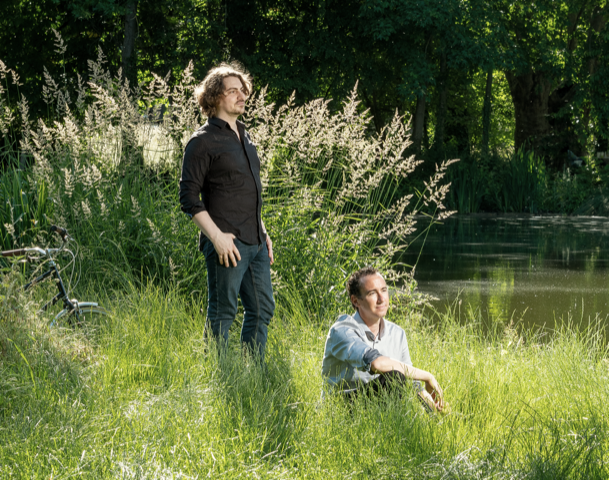
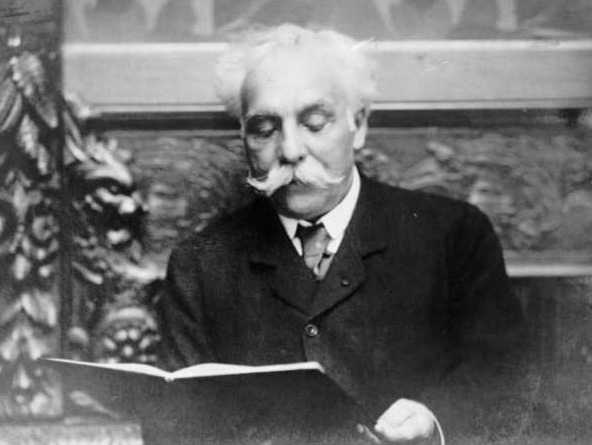
Fauré’s melodies are quiet luxuries in themselves. Their subtle elegance, depth of emotion and compositional introspection make them so. The composer’s setting of Paul Verlaine’s “Clair de Lune” readily exemplifies these traits while the minimalist melody of “Aprés un Rêve” by an anonymous poet, shows the mature Fauré in his most contemporary and efficient mode. The extraordinary range of songs and exploration Fauré’s evolution bestow “essential” status on this collection.
To be sure, the seamless collaboration of Dubois and Raes remains fresh and never approaches atmospheric sameness. They provide further variety by eschewing strict chronology in favor of three deftly constructed recitals. The first features Fauré’s early compositions influenced by Romanticism, the next takes on the complexity of his mature works and lastly the composer’s final creative period is explored when he moved toward an economy of expression. Citing favorites is a fool’s task here. One is better served by reveling in the recording’s ravishing detail and sequential elegance.
Many of Fauré’s mélodies were written for different voices, and in order for Dubois and Raës to interpret them there were cases in which new transpositions had to be adopted. While I did not compare each of their renditions with the originals (happily such changes do not avail themselves on the recording) it is apparent that harmonic colors and tonal coherence have been assiduously maintained. Where gender might be an issue, Dubois in a promotional video interview stated simply that one does not have to be a woman to tell a woman’s story.
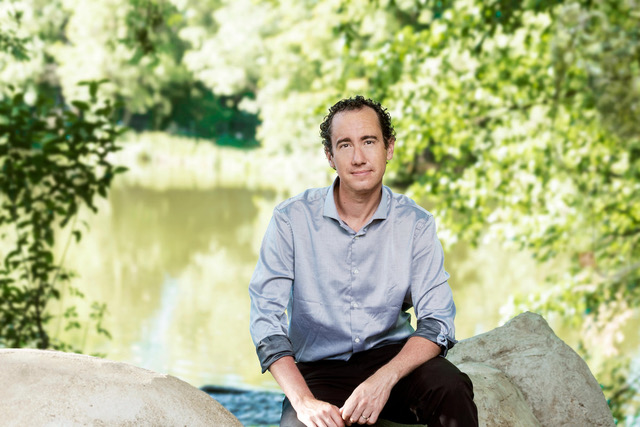
Jouissons de nos baeux ans! (Let us enjoy our finest years!) is a whole other matter. It’s a celebration of the French Baroque in which France was a shining (albeit doomed) example of cultural and artistic refinement. The recording provides Dubois with the opportunity to present works that were written specifically for the haute contre voice.
Yes, it is laden with Jean-Philippe Rameau but Dubois and his collaborators have earnestly sought to bring lesser know works to light by such composers as Antoine Dauvergne and Jean-Joseph Cassanéa de Mondonville. So while you enjoy selections from Rameau’s Platée and La Gurlande, in which Dubois is joined by orchestra and chorus, you will also hear Mondonville’s spectacular if mournful monologue from Titon et l’Aurore, and Dauvergne’s “La jeune beauté…” from Les Amore de Tempé in which Dubois lets go with gorgeous ornamentation and heroic expression.
The participation of the Orfeo Orchestra, Purcell Choir and Gyorgy Vashegyi equip Dubois with first-rate partners. The recording feature independent orchestral and choral works such as Rameau’s furious overture to Zaïs and the angry chorus from Pierre Iso’s Phaétuse. This is an impressive programming giving the recording a festive and celebratory air.
Dubois records exclusively on the Aparte label and it is worth mentioning that these recordings add tactile as well as aural satisfaction in their “hard copy” form. It’s difficult to get one’s mind around the concept of digital luxury, if there is such a thing, quiet or otherwise. But if that becomes your only alternative, you will still be rewarded.
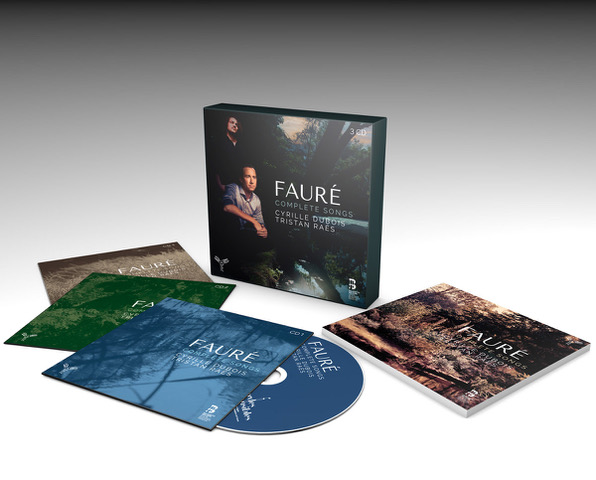
Aparte’s packaging of the three-disk Fauré boxed set is tidy and atmospheric, an epic musical journey in a space-saving box. Jouissons’s single disk is enclosed in a slim tri-fold sleeve repeat with photos of Dubois hoisting a golden apple that stands as a quiet expression of the French Baroque’s otherwise ornate luxury. Both are eco-friendly and contain substantial booklets with photographs, essays and, most importantly, French-English translations.
Note: Hard copies of these recordings are available at Apartemusic.com, where you can search Cyrille Dubois. As of this writing they are both available.
Comments