
Carmen: another Tillotson triumph
Review
If you’re going to present Carmen, you’d better have a great Carmen. Regina Opera, blessed with the talents of Lara Michole Tillotson, indeed had just that. Ms. Tillotson, who has driven the success of Regina Opera’s productions of The Medium (as Madam Flora) and Il trovatore (delivering one of the all-time great renditions of “Stride la vampa”) once again triumphed here. Her strong, sexy, independent – even feminist – rendition of Georges Bizet’s titular character was as great as you will find on any opera stage. First and foremost, Ms. Tillotson is an actress, who doesn’t rest on the laurels of her vocal gifts (which are prodigious). Another requirement for the role is to be a convincing dancer and here, again, Ms. Tillotson more than fills the bill.
Carmen is, of course, a perfect show on paper; the libretto and score are true partners. Every scene and musical moment is memorable; nothing is perfunctory or wasted.

The story is about the conflict between lust and love, or lust and obsession, and at the center of it all is opera’s hottest heroine - a woman who knows what she wants, or rather what she doesn’t want - that is, to be owned. The value of liberty here is seen as more valuable than life itself, especially among the libertines. Carmen lets us know right away in her introductory aria (“Habanera”) that she isn’t interested in monogamy, but the smitten soldier Don José isn’t paying attention to the lyrics. He gives up his entire life, family and career for her, only to be jilted as Carmen moves on to the toreador Escamillo. Tragedy is inevitable and although there is foreshadowing in the plot and in the underscoring (the famous descending bass clef notes that serves as a counterpoint to the snappy toreador theme) we’re not quite sure how all of this is going to play out until the final shocking moments. The drama of it all, is riveting theatre for the entire three+ hours.

The great scenes carefully created by composer Bizet and librettists Meilhac and Halevy, were all there. Yeawon Jun, as the sad, jilted Micaela delivered a lovely “Je dis que rien ne m’épouvante”. The famous Act II “Quintet” with its rapid turn-taking between soprano (Veronica Mak), mezzos (Ms. Tillotson and Manya Gaver-Holmes,) baritone (Keunwon Park) and tenor (Thibault Courtois) was adroit and flawless and prompted one of the biggest ovations in the program. And Seoyong Lee as Escamillo commanded the stage during his Toreador song (“Votre toast, je peux vous le rendre”).
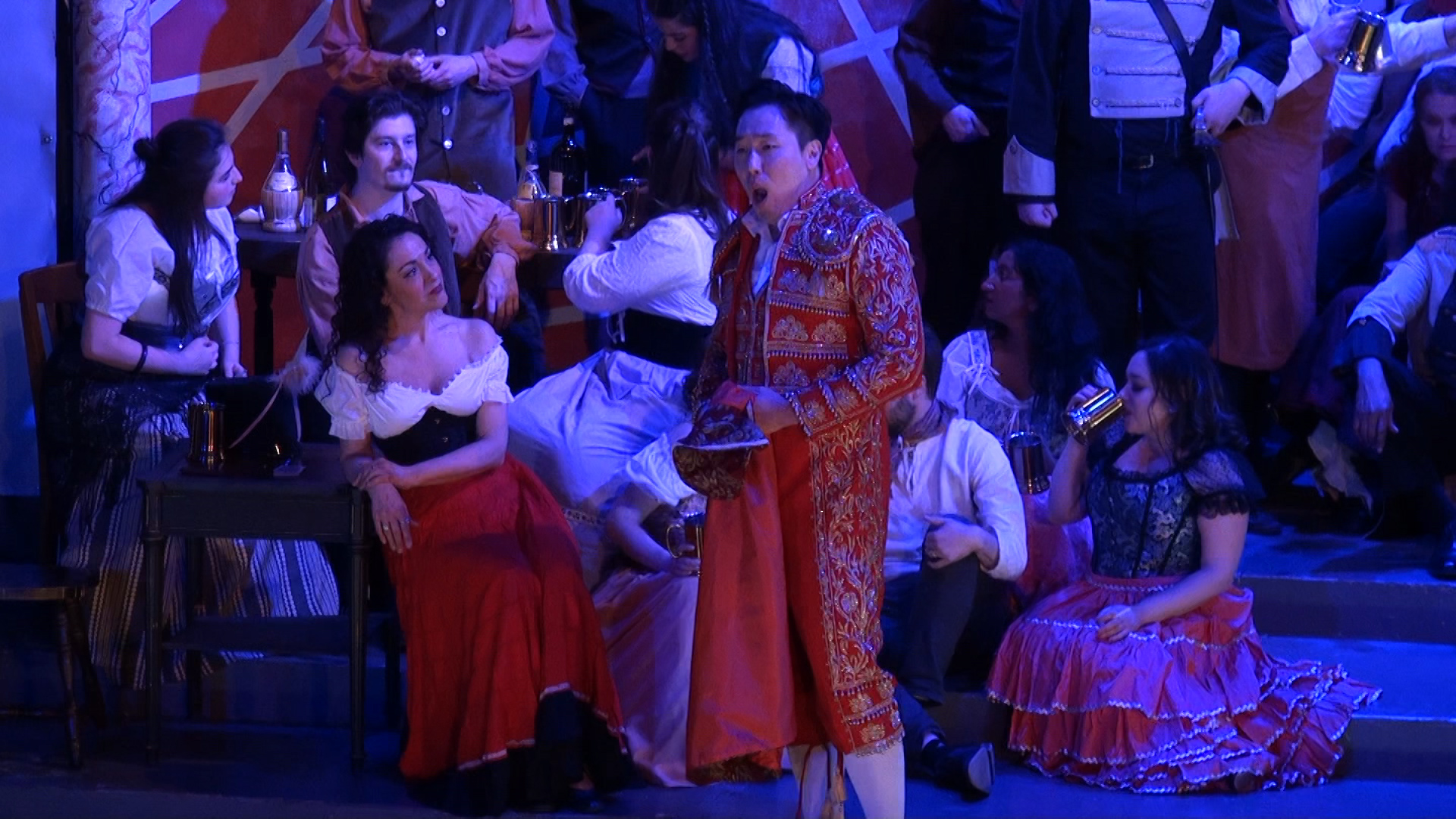
In the starring role of Don José, Jax Hassler has a powerful full-bodied tenor throughout his range, reminiscent of a young Plácido Domingo, and, like Domingo, really “rings the bell” at the top of his top notes. He also believably conveys the tortured soul of Don José and his slip into madness. Mr. Hassler would have benefited greatly, however, with some direction as far as stage presence is concerned. Stage Director Helen Van Tine offered no help here. Mr. Hassler either stood still or awkwardly wandered and, for some reason, had nothing to do during the entire “Habanera” except repeatedly examine and stroke a rifle he was holding. Ms. Van Tine also offered no help in bringing life to most of the other participants on stage. The chorus stood or sat like statues for most of the evening, staring fixedly at the pit for their cues.
Luckily, first-class singers and musicians can always be expected at Regina Opera, and here was no exception. The men’s and women’s chorus, separate for most of the show, were both splendid under the Choral Conductor Emily Loa-Swaim as was, as always, the orchestra under the baton of Scott Jackson Wiley.
And so we have the usual dichotomy as expected at every Regina Opera production. The sets appeared to be from a middle-school production and the lighting was insufficient; the performers found themselves half-lit at the downstage lip of the stage. With seemingly no understanding of this issue, Stage Director Ms. Van Tine continually placed her performers there. Regina Opera continues to be first-class music-making in threadbare surroundings.
Note: Regina Opera uses multiple casts, with most of the performers mentioned here appearing in only two of the scheduled six performances. Kudos for the creation of so many opportunities for professional performers.
Comments