
Barbara Hannigan: A Force of Nature
Review
If there were a fleet of Barbara Hannigans, the musical world would be a vastly different place. But there is only one and we are grateful for her presence.
Hannigan is the force of nature who swept through Lincoln Center’s David Geffen Hall for a three-performance run with the New York Philharmonic. She conducted Richard Strauss’ turbulent and disconsolate Metamorphosen and followed it by singing and conducting Francis Poulenc’s tragic one-person opera, La voix humaine.
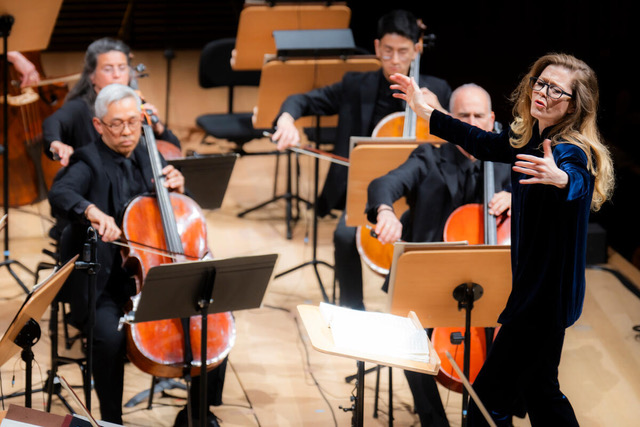
And if that isn’t impressive enough, Hannigan also acted. But how did she do all of this? Great determination, a keen musical sense, and an unerring drive for artistic adventure are contributing factors. Hannigan’s seemingly unlimited vocal range and comfort with a spectrum of musical styles complete the picture of this Canadian soprano who is billed, quite matter-of-factly in the playbill, as “conductor-soprano”.
Conductors often shape their approach to a composition long before meeting the orchestra. Rehearsals then are devoted to realizing that approach. Conducting styles, be they taciturn or flamboyant, vary for reasons of musical and personal style. Hannigan creates a character on the podium. She employs a wholly unique set of tools that are expansive in gesture and body movement. For the most part they coalesce with traditional methods of leading an orchestra.
They did not coalesce, however, in what were murky opening moments of Metamorphosen, Strauss’ response to the death of German culture at the hands of Nazi policy and Allied bombings. Its beginning, more amorphous than elusive, didn’t take shape until Hannigan employed dramatic swan-like gestures that are more akin to the graceful but deliberate ambience of Sibelius’ “The Swan of Tuonela”, than to anything smooth and swooping.
Hannigan was aided by the strings of the Philharmonic, playing with refinement and taut sophistication when touching upon the funeral march from Beethoven’s “Eroica” Symphony.
Possessing an impressive emotional gravitas of their own, the ensemble produced passages of fleeting loveliness, bitter irony in this context, that evoked Strauss’ probing “Mondscheinmusik”, and the wistful regret of the Marschallin’s monologue. Such was the impact of a polished ensemble and a conductor’s character on the podium.
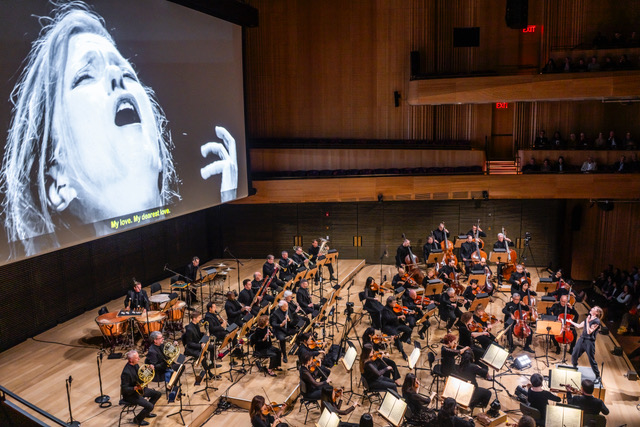
Hannigan would reemerge to sing and conduct Poulenc’s La voix humaine following a short break allowing for a quick costume change and assembly of the full orchestra. A giant video screen that had hovered ominously over the stage came alive with a real-time projection from behind the orchestra. While Hannigan’s back was to the audience, we saw her from the orchestra’s point of view.
Jean Cocteau’s play to which the opera closely adheres, eschews linear story-telling and the conventions of rational conversation. We are privy to one side of a telephone conversation; a woman telephones her ex-lover who is now is love with another. Only wrong numbers and bad connections keep this monologue from drifting off into the surreal. Cornering the “d” words, the women is desperate, deluded and deceptive. Hannigan plays to the camera with unabashed narcissism. It’s risky business, even in a 40-minute opera, but Hannigan is also keeping tight control of the orchestra as it wades through the many lyrical motifs and instrumental bridges. So the woman becomes infinitely more tolerable.
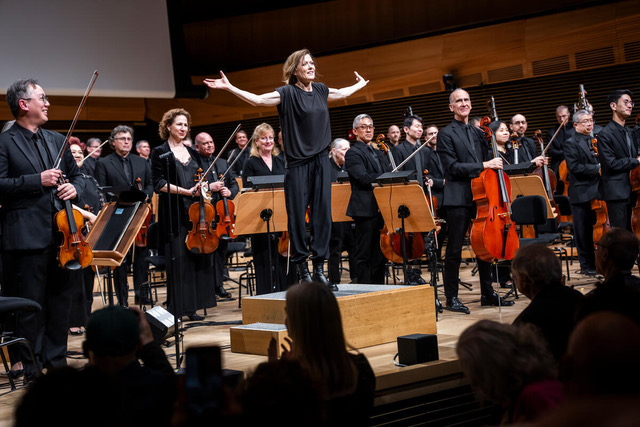
While the women’s admission of attempted suicide reeks of base manipulation, we admire Hannigan’s energy, dramatic prowess, and her ability to lead the orchestra with stylized gesture. Poulenc, who likely never imagined a singing conductor, nonetheless facilitates Hannigan by assigning only portions of the orchestra when the woman is singing thus concentrating her multi-tasking. Though it shouldn’t, it feels like an afterthought, a foregone conclusion, to note that Hannigan thrills with her vocal agility and clarity, cutting relentlessly through the emotional fog.
The video screen abandons real-time visuals in favor of various forms of montage and other techniques that duplicate Hannigan turning her into video fodder. Under the supervision of video artist, Clemens Malinowski, we are offered a visual representation of the woman’s mind and her struggle with encroaching reality, even as she claims to wrap the phone cord around her neck. We might plead over-sharing here but the veracity of the production and the bond between Hannigan and the New York Philharmonic leave us, in the words of Blondie, that great mid-70s’s band, hanging on the telephone.
Comments